

Selling your business in 2026 could be a smart move. With strong economic growth in Ireland, lower interest rates (down to 2.15% by 2025), and a high demand for SMEs due to retiring owners, the market is ripe for sellers. But to secure the best deal, preparation is key. Here’s what you need to know:
- Set clear goals: Define personal, financial, and business priorities before starting the process.
- Assess readiness: Ensure your business can operate without you, financial records are up-to-date, and you’re compliant with 2026 regulations like e-invoicing and auto-enrolment pensions.
- Understand valuation: Learn how Irish SMEs are valued using EBITDA multiples, DCF, or asset-based methods.
- Fix issues early: Address tax, legal, and operational gaps at least 12–18 months in advance.
- Target buyers effectively: Know whether you’re appealing to trade buyers, MBOs, private investors, or international acquirers.
- Maximise value: Focus on predictable revenue, profit margins, and reducing dependency on key people or customers.
- Plan the sale process: Assemble a team of professionals, create a sales dossier, and organise a virtual data room for due diligence.
With favourable market conditions and proper planning, 2026 offers a strong opportunity to sell your Irish SME successfully.
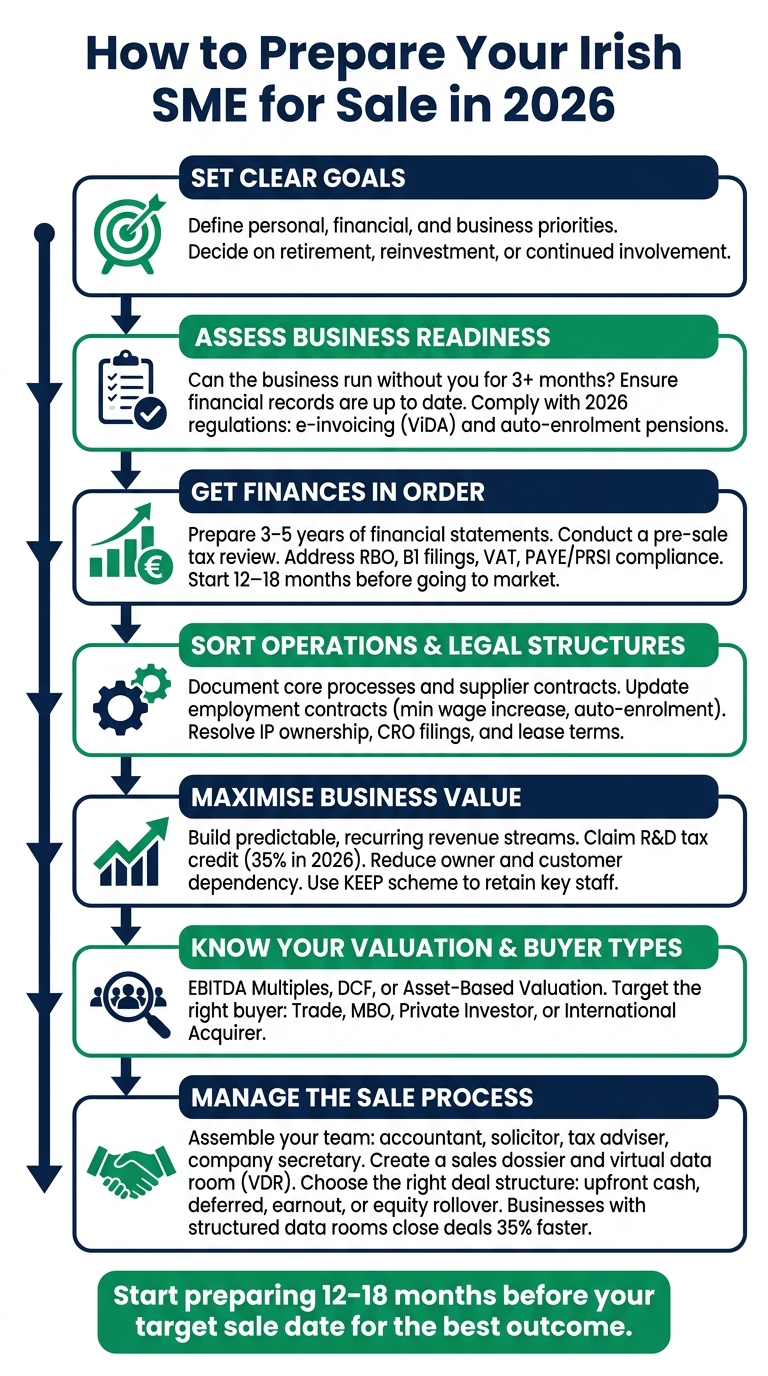
How to Prepare Your Irish SME for Sale in 2026: Step-by-Step Guide
Set Clear Goals for Your Business Sale
Before diving into the sale process, take a step back and define what you hope to achieve. This is a step many Irish business owners overlook, often leading to decisions that don’t align with their true priorities. Your goals will influence everything: the timeline, the type of buyer you seek, and even the deal structure you negotiate.
Think about your objectives across three areas: personal, financial, and business. Are you planning to retire completely, or do you see yourself staying involved in some capacity? Financially, is your aim to pay off debts, secure your retirement, or fund a new venture? From a business perspective, do you care if the company retains its name and identity, or are you less concerned about what happens after your exit? Laying out these priorities early can save you from costly changes later in the process.
"Whether a business stays within a family, transitions to employees, or is acquired by another company, thoughtful planning helps ensure the business remains strong." – First Citizens National Bank
Set Your Exit Timeline and Check Your Readiness
Selling a small or medium-sized business in Ireland isn’t a quick process. It typically involves several stages: preparing the business for sale, finding and engaging buyers, managing due diligence, and finally, completing the handover. Rushing through any of these can hurt your chances of securing an optimal deal – or even cause the deal to fall apart.
Start by assessing your readiness. Ask yourself: could the business operate smoothly without you for three months? Are your financial records accurate and up to date? Have you addressed the EU’s upcoming VAT in the Digital Age (ViDA) e-invoicing requirements, which begin rolling out in 2026? Buyers will scrutinise these details during due diligence, so identifying and fixing any gaps now can save you headaches later.
"Those who act early [on digital tax compliance] will avoid disruption later." – Dave O’Brien, Head of Tax, Xeinadin
Know What You Are Selling
One of the first big decisions you’ll face is whether to sell the shares in your company or its assets. This choice has major tax and liability implications for both you and the buyer.
In a share sale, the buyer takes over the entire company – including its history, contracts, and liabilities. Sellers often prefer this route because it can qualify for Entrepreneur Relief, which offers a 10% Capital Gains Tax (CGT) rate on the first €1.5 million of qualifying gains. On the other hand, an asset sale allows the buyer to pick and choose specific assets, such as equipment, intellectual property, or customer lists, while leaving behind unwanted liabilities. While buyers may lean toward this option for its reduced risk, it can mean a higher tax burden for sellers. Consulting a tax adviser early on is critical for navigating these complexities.
"Engage early with your tax advisor to plan succession, investment, and sustainability strategies around these reliefs." – Dave O’Brien, Head of Tax, Xeinadin
This decision will also influence which types of buyers are most likely to be interested in your business.
Know Your Likely Buyer Types
Different buyers evaluate businesses in different ways, so understanding who might buy yours can help you position it more effectively. Here are the main buyer types in the Irish SME market:
| Buyer Type | What They’re Looking For | How They Value the Business |
|---|---|---|
| Trade buyers | Market share, customer base, and synergies | A strategic premium based on overall performance |
| Management buyout (MBO) | Continuity and familiarity with operations | Conservative valuation, often requiring financing |
| Private investors | Strong cash flow and minimal owner dependency | Valuation based on earnings multiples |
| International acquirers | Entry to the Irish market or access to talent | Potential premium for strategic positioning |
For instance, a trade buyer, such as a competitor looking to grow their market share, might pay more because they can benefit from synergies that aren’t reflected in your standalone financials. On the other hand, an MBO might offer a smoother transition, though often at a lower price. If your business has a capable management team in place, it becomes more appealing to private investors and international buyers who want a hands-off investment. Understanding these dynamics is key to crafting a strong exit strategy.
sbb-itb-755c06c
Get Your Finances in Order
Once you’ve determined what you’re selling and who your target audience is, it’s time to focus on your finances. Potential buyers – whether they’re trade acquirers, private investors, or international firms – will look closely at your financial details. Missing or incomplete records can slow down due diligence and shake buyer confidence. Below are the key steps to ensure your financials are ready for scrutiny.
Organise Your Financial Records
Start by making sure your financial records are complete and up to date.
Buyers typically expect to see three to five years’ worth of financial statements, including profit and loss accounts, balance sheets, and cash flow statements. They’ll also want to review tax returns, VAT records, payroll summaries, and management accounts. Double-check that all these documents are reconciled and consistent.
Two areas deserve extra attention in 2026: e-invoicing compliance and pension liabilities. The EU’s VAT in the Digital Age (ViDA) initiative is rolling out this year, requiring Irish businesses to adopt digital reporting for B2B transactions. If your invoicing system isn’t compatible, it could raise concerns for buyers. Additionally, the new "My Future Fund" Auto-Enrolment (AE) pension scheme, launched on 1 January 2026, mandates employer contributions starting at 1.5% of gross pay, increasing to 6% over the next decade. Buyers will expect these costs to be factored into your financial projections.
"Those who act early [on e-invoicing] will avoid disruption later." – Dave O’Brien, Head of Tax, Xeinadin
Learn How Irish SMEs Are Valued
Understanding how buyers value businesses helps you set realistic expectations and pinpoint areas for improvement. In Ireland, the three most common valuation methods for SMEs are EBITDA Multiples, Discounted Cash Flow (DCF), and Asset-Based Valuation. Each method works differently and suits different types of businesses:
| Valuation Method | How It Works | Best Used For | Watch Out For |
|---|---|---|---|
| EBITDA Multiples | Multiplies earnings before interest, tax, depreciation, and amortisation by an industry-specific figure | Profitable, stable businesses with consistent earnings | Sector and size can cause wide variations in multiples |
| Discounted Cash Flow (DCF) | Forecasts future cash flows and discounts them to present value | Businesses with steady, recurring revenue streams | Relies heavily on assumptions and can be complex |
| Asset-Based Valuation | Adds up the net value of tangible and intangible assets | Asset-heavy businesses or those with lower profitability | May undervalue goodwill, brand reputation, or customer relationships |
For most Irish SMEs, EBITDA multiples are the go-to starting point. However, in 2026, buyers are placing more emphasis on cash flow stability and protecting profit margins, particularly with inflation and rising employment costs in play. Businesses using digital tools to streamline bookkeeping or reporting are also viewed favourably. AI-powered systems, capable of automating up to 75% of routine reconciliation tasks, are seen as an indicator of scalability.
Fix Tax and Financial Issues Early
Conducting a pre-sale tax review is critical. Common issues that surface during due diligence include unpaid taxes, undocumented director loans, missing annual returns, and incomplete beneficial ownership records.
In Ireland, companies are required to register beneficial owners – those holding 25% or more of shares or voting rights – with the Central Register of Beneficial Ownership (RBO). Non-compliance can lead to fines of up to €500,000. You’ll also need to ensure your Form B1 annual return is filed with the Companies Registration Office (CRO) every year, verify your VAT registration status against the current thresholds (€85,000 for goods, €42,500 for services), and confirm that all PAYE and PRSI obligations are up to date. Use Form TR2 to check that your Corporation Tax, VAT, and PAYE registrations are active and accurate.
| Requirement | What to Check | Potential Red Flag |
|---|---|---|
| Beneficial Ownership (RBO) | Register all owners with >25% control | Fines up to €500,000 for non-compliance |
| Annual Returns (B1) | Must be filed annually with CRO | Late filings can result in penalties or company strike-off |
| Corporation Tax | 12.5% for trading income, 25% for passive income | Unpaid taxes or missing returns |
| VAT Registration | Thresholds: €85k (goods), €42.5k (services) | Failure to register when thresholds are exceeded |
| PAYE/PRSI | Ensure all employee tax and social insurance are current | Arrears or incorrect classifications |
"Practical action will help Irish businesses make the most of what’s available." – Dave O’Brien, Head of Tax, Xeinadin
Addressing these issues at least 12 to 18 months before going to market gives you time to resolve problems without stress. This preparation ensures your business meets buyer expectations and sets the stage for a smoother sale process.
Sort Out Operations and Legal Structures
Once your financial records are squared away, it’s time to focus on your operations and legal frameworks. These areas are crucial for building buyer confidence. Up-to-date documentation, contracts, and legal compliance can prevent delays and even protect your business’s valuation. Buyers want to see a well-oiled operation that doesn’t depend entirely on the owner.
Document How Your Business Runs
Lack of documented processes can be a red flag for buyers. Start by detailing your core operations, such as order processing, customer support, and recurring workflows. Make sure supplier agreements and service contracts are clearly documented.
Formal, long-term supplier contracts are especially important in 2026. With market volatility, buyers need assurance of stable future cash flows. A verbal agreement with a key supplier won’t cut it. If you’re relying on informal arrangements, now’s the time to formalise them. The same goes for customer contracts, particularly if a handful of clients contribute significantly to your revenue. Your goal is to make your operational processes easy for buyers to understand and trust.
Update Employment Practices and Governance
Operational documentation is just one piece of the puzzle. Ensuring your employment practices are current is equally important to avoid compliance risks. Outdated employment contracts often surface during due diligence, so review them carefully. Reflect recent changes, such as the €0.65-per-hour increase in the national minimum wage introduced in Budget 2026, and the new auto-enrolment pension contributions that became mandatory on 1 January 2026. Missing these updates in your contracts or payroll systems could raise red flags for buyers.
To retain key staff during the transition, consider using the Key Employee Engagement Programme (KEEP), which allows for tax-efficient share options and has been extended to 2028.
"In an environment of rising wages and competition for talent, KEEP remains a powerful tool." – Dave O’Brien, Head of Tax, Xeinadin Ireland
Governance is another area gaining attention. Buyers and lenders increasingly value ESG (Environment, Sustainability, and Governance) credentials. While a full sustainability report isn’t necessary, tracking governance practices and basic sustainability metrics can enhance your appeal, especially if your buyer is an institutional or international investor.
Resolve Legal and Regulatory Issues
A legal health check is essential. Review your CRO filings, property leases, intellectual property (IP) ownership, and compliance with e-invoicing regulations.
Ensure your Companies Registration Office filings are current, and confirm that any IP – like trademarks, software, or proprietary processes – is clearly owned by the business rather than you personally. If your business operates from leased premises, examine the lease terms. A short lease with no renewal option could be a dealbreaker, particularly in industries like retail or hospitality.
On the digital side, Revenue’s phased roll-out of e-invoicing under the VAT in the Digital Age (ViDA) initiative is already in motion for B2B transactions in 2026. Make sure your systems comply to avoid complications during due diligence.
Engage an Irish solicitor as early as possible – ideally 12 to 18 months before you plan to sell. Legal issues can take time to resolve, and having everything in order before buyers start asking questions will put you in a much stronger negotiating position. These steps will help you lay the groundwork for a smoother sale process.
Increase the Value of Your Business Before Selling
Making targeted improvements in areas that buyers prioritise can significantly influence the final sale price of your business. Even small adjustments can make a big difference.
Focus on What Buyers Look For
Buyers tend to value businesses with predictable revenue streams, healthy profit margins, and a diverse customer base. Over the next 12–18 months, aim to strengthen these areas. A business with steady, recurring income is far more attractive than one with unpredictable, project-based revenue. Stability reduces risk, and buyers are often willing to pay more for that peace of mind.
Another area to consider is investment in research and development (R&D). With the R&D tax credit rate set to increase to 35% in 2026 (up from 30%), and the first-year payment threshold rising to €87,500, businesses that invest in qualifying R&D can not only benefit financially but also demonstrate a forward-thinking approach to growth.
"As a key driver of economic growth and high value employment, Research and Development supports are critical to Ireland’s continuing competitiveness." – Paschal Donohoe, Minister for Finance
Make sure to claim any eligible R&D expenditure under the higher rate before putting your business on the market. This move can strengthen your cash flow and show potential buyers that your business is built for the future.
Improve Profitability and Cash Flow
Buyers are drawn to businesses that show financial discipline alongside strong revenues. For Irish SMEs, two key areas to focus on are labour costs and pricing strategies.
- Labour Costs: Keeping a full-time minimum wage employee under 38 hours per week ensures the employer PRSI rate stays at 9%, helping to manage costs efficiently.
- VAT Savings: If you operate in sectors like food, catering, or hairdressing, note that the VAT rate will drop from 13.5% to 9% on 1 July 2026. This change allows you to retain €3.63 more for every €100 in sales. Additionally, the extended 9% VAT rate on gas and electricity until 31 December 2030 can help reduce fixed operational expenses.
If cash flow is a concern, consider low-cost funding options from institutions like the Strategic Banking Corporation of Ireland (SBCI) and Microfinance Ireland. They offer loans ranging from €5,000 to €50,000, with terms up to three years. These can provide support during the due diligence process without the burden of high-interest debt.
Reduce Reliance on Key People and Key Customers
A business overly dependent on its owner or a few key customers can deter buyers. They see these dependencies as risks that could impact operations post-sale.
To address this, document critical processes and ensure staff are cross-trained. This makes your business less reliant on you and more attractive to buyers. By 2026, segmented pricing by buyers and lenders will reward businesses with lower dependency risks, offering better terms and valuations.
Similarly, diversify your customer base to reduce reliance on a handful of clients. A broader customer portfolio lowers risk and increases buyer confidence.
Lastly, consider using the Key Employee Engagement Programme (KEEP) to retain essential staff. Offering tax-efficient share options to key team members before selling can reassure buyers that the business will retain its talent and operational stability during the transition.
Manage the Sale Process and Due Diligence
Once you’ve fine-tuned your business’s finances and operations, it’s time to focus on managing the sale process. This stage is critical in meeting the expectations of Irish SME buyers. To do it right, you’ll need careful planning, a skilled team, and a thorough approach.
Assemble the Right Professional Team
Selling a business in Ireland involves a team of trusted advisers who understand the ins and outs of SME transactions. Here’s who you’ll need:
- Accountant: Keeps your financial records accurate and up-to-date.
- Solicitor: Drafts legal agreements and ensures compliance with Irish laws.
- Tax Adviser: Looks for ways to reduce your tax burden, such as qualifying for Entrepreneur Relief, which lowers Capital Gains Tax (CGT) to 10% on the first €1 million of a sale.
- Company Secretary: Ensures all filings with the Companies Registration Office (CRO) are current, avoiding delays during legal reviews.
"Engaging with experts can help you make informed decisions and optimise the outcome of your exit strategy." – Kinore
Start working with these professionals 12 to 18 months before you plan to sell. Once your team is in place, the next step is to get your documentation in order.
Create a Sales Dossier and Data Room
Buyers need clear, well-organised documentation to make informed decisions. Being prepared can speed up the process significantly. In fact, businesses with well-structured data rooms close deals 35% faster, while incomplete or messy documentation is a leading cause of failed deals (68%).
A virtual data room (VDR) is an excellent tool for securely sharing sensitive documents. Unlike regular cloud storage, VDRs offer advanced features like detailed access controls, watermarking, and tracking to monitor buyer activity. Use a staged approach to sharing information: start with a high-level summary under a signed NDA, then provide access to basic data, and finally, grant full access to shortlisted buyers.
To keep things organised, use a numbered folder system in your data room:
| Index | Folder | Key Contents |
|---|---|---|
| 1.0 | Corporate | Articles of incorporation, board minutes, shareholder agreements |
| 2.0 | Financial | 3–5 years of audited accounts, management accounts, tax returns, projections |
| 3.0 | Legal | Customer/supplier contracts, licences, permits, litigation records |
| 4.0 | HR | Org charts, employment agreements, compensation plans |
| 5.0 | IP & Tech | Patents, trademarks, software licences, cybersecurity results |
| 6.0 | Operations | Leases, asset registers, vendor agreements |
| 7.0 | Tax | Tax returns, Revenue correspondence, audit status |
| 8.0 | Commercial | Top customer contracts, sales data, market expansion plans |
It’s also essential to ensure that all founders, employees, and contractors have signed IP assignment agreements. Missing documentation for intellectual property often causes delays during due diligence.
Know the Common Deal Structures in Irish SME Sales
Not all business sales are straightforward cash deals. The structure of your sale impacts your tax obligations, risk exposure, and how quickly you get paid. Understanding these structures before negotiations can give you an edge.
"Where a valuation gap exists between what a buyer is willing to pay and a vendor is willing to accept for a business, an earnout mechanism is often negotiated to bridge the gap." – Úna Ryan, Tax Partner, Grant Thornton
Here’s a breakdown of the most common deal structures:
| Deal Structure | Best For | Tax Implication (Ireland) | Risk Level |
|---|---|---|---|
| Upfront Cash | Sellers wanting a clean exit and immediate liquidity | CGT due immediately on 100% of value | Low (for seller) |
| Deferred Payment | Bridging a buyer’s temporary funding gap | CGT usually due on the full amount at completion | Medium (buyer default risk) |
| Earnout | High-growth businesses or bridging valuation gaps | CGT often due upfront on "ascertainable" amounts | High (performance-dependent) |
| Equity Rollover | Sellers who believe in the buyer’s future growth | CGT deferred on the share portion (Rollover Relief) | Medium (market/equity risk) |
Be aware that for deferred payments, CGT is owed on the full sale price at the time of completion, even if part of the payment is delayed for years. This often catches first-time sellers off guard, so consult your tax adviser early.
If a management buyout (MBO) is on the table, the management team typically forms a "BidCo" to secure debt for the purchase. This is important because payments made directly from company funds may be taxed as income distributions rather than capital gains, leading to a much higher tax bill.
Choosing the right deal structure is just as important as preparing your business for sale. It ensures you maximise value while keeping the process efficient. Platforms like Bizmark can connect you with serious buyers, cutting down on unqualified leads and keeping the sale on track.
Conclusion
Get ready now to sell your Irish SME successfully in 2026. The best sellers treat the sale as an ongoing process, not just a one-time event. That means keeping your financials in order, documenting your operations thoroughly, resolving any legal issues, and ensuring your team is on the same page.
The strategies outlined here, combined with the favourable market conditions expected in 2026, can significantly enhance your chances of a profitable sale. This year’s market rewards early and detailed preparation. Make the most of beneficial tax measures, such as the increased Entrepreneur Relief limit and the improved R&D tax credit. Additionally, the generational shifts happening among Irish SMEs create excellent opportunities for those who are ready.
"Those who act early will avoid disruption later." – Dave O’Brien, Head of Tax, Xeinadin Ireland
The steps in this guide aim to make your business more attractive to buyers and simplify the selling process. Starting early gives you access to better, more strategic options.
Take advantage of these opportunities, prepare ahead, and list your business with Bizmark to connect with serious buyers. With no upfront fees for sellers and full support for valuation, confidentiality, and negotiations, Bizmark offers a simple and effective way to reach vetted buyers actively seeking Irish SMEs.
FAQs
When should I start preparing to sell?
Preparing to sell your business is not something you should leave until the last minute. If you’re aiming for a sale in 2026, it’s wise to start getting ready as early as 2025 – or even sooner. Why? Early preparation gives you the chance to fine-tune your financials, smooth out operations, and increase the overall appeal of your business.
Taking proactive steps, like conducting a thorough review of your financial records and resolving any potential issues, ensures your small or medium-sized enterprise meets market expectations. This groundwork not only boosts your business’s attractiveness to potential buyers but also helps you get the best possible outcome from the sale.
Should I sell shares or assets?
Deciding whether to sell shares or assets hinges on your business’s specific situation, the buyer’s preferences, and the tax impact. Opting for a share sale means transferring ownership of the entire company, which can sometimes come with tax benefits. On the other hand, an asset sale involves selling individual business assets, offering more control over what’s included in the sale.
Key considerations include tax obligations, potential legal liabilities, and the nature of your business. To make the right choice, it’s essential to consult a tax or legal expert who understands the nuances of the Irish market. Their guidance will help you navigate these complexities effectively.
What will buyers focus on in 2026?
In 2026, buyers will focus on financial stability, operational efficiency, and the growth potential of Irish SMEs. They’ll also evaluate how businesses handle economic challenges, adapt to regulatory shifts, and embrace digital transformation. Preparing your business to excel in these areas can significantly increase its appeal to potential buyers.