Confidentiality is key when selling your business in Ireland. A public sale can lead to competitors exploiting sensitive information, employees leaving, and customers losing trust. To avoid these risks and protect your business’s value, follow these steps:
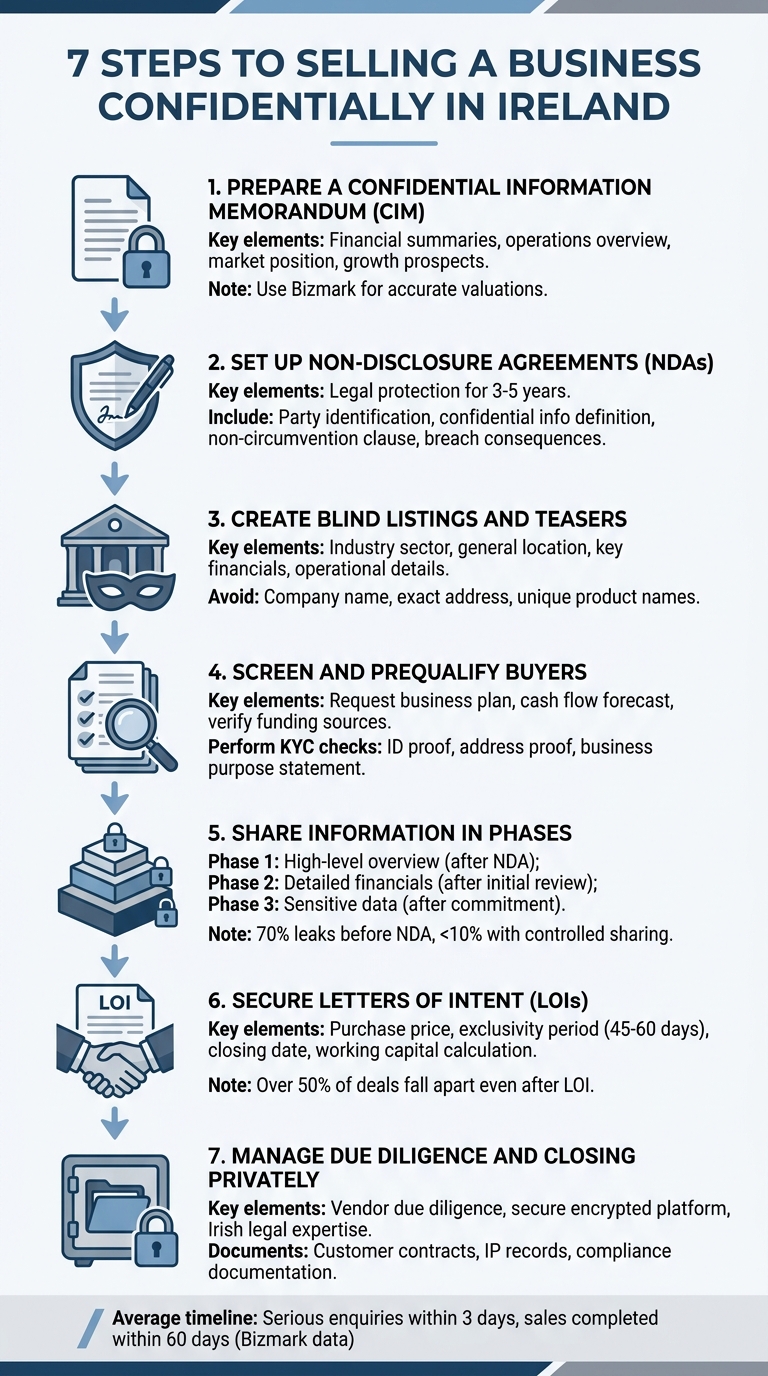
Prepare a Confidential Information Memorandum (CIM): Create a detailed document showcasing your business’s strengths while protecting sensitive details. Include financial summaries, operations, market position, and growth prospects. Use tools like Bizmark for accurate business valuations.
Set Up Non-Disclosure Agreements (NDAs): Ensure potential buyers sign legally binding NDAs to safeguard your data.
Use Blind Listings and Teasers: Market your business discreetly without revealing its identity. Highlight key financials and advantages while keeping specifics private.
Screen and Prequalify Buyers: Verify buyers’ financial capacity and intent through documentation and checks before moving forward.
Share Information in Phases: Disclose sensitive details gradually, starting with high-level overviews and using secure data-sharing platforms.
Secure Letters of Intent (LOIs): Formalise buyers’ interest with non-binding agreements outlining key terms and exclusivity periods.
Manage Due Diligence and Closing Privately: Share critical data securely, address potential issues early, and work with Irish legal experts to finalise the sale.
7 Steps to Selling Your Business Confidentially in Ireland
Keep it a Secret: Confidentiality | How to Sell a Business – David C. Barnett
sbb-itb-755c06c
Step 1: Prepare a Confidential Information Memorandum (CIM)
A Confidential Information Memorandum (CIM) is a detailed document that presents your business’s key strengths while safeguarding sensitive details. Shared only after an NDA is signed, it acts as a professional sales brochure, designed to showcase your business while maintaining confidentiality throughout the selling process.
What to Include in Your CIM
Your CIM should provide a well-rounded view of your business, focusing on four main areas:
Financial Summary: Include recent profit and loss statements, balance sheets, and cashflow forecasts. Use Irish-specific templates to ensure compliance. For reference, Irish SMEs are defined as businesses with fewer than 250 employees and either an annual turnover not exceeding €50 million or a balance sheet total not exceeding €43 million.
Market Position: Highlight your competitive strengths, but avoid revealing trade secrets.
Growth Prospects: Outline opportunities for expansion and include any existing contracts that could attract potential buyers.
Accurate financial data is critical in each section to support your asking price. It’s a good idea to consult a financial advisor to ensure all figures are precise and professionally presented.
Using Bizmark‘s Valuation Service for Accurate Figures
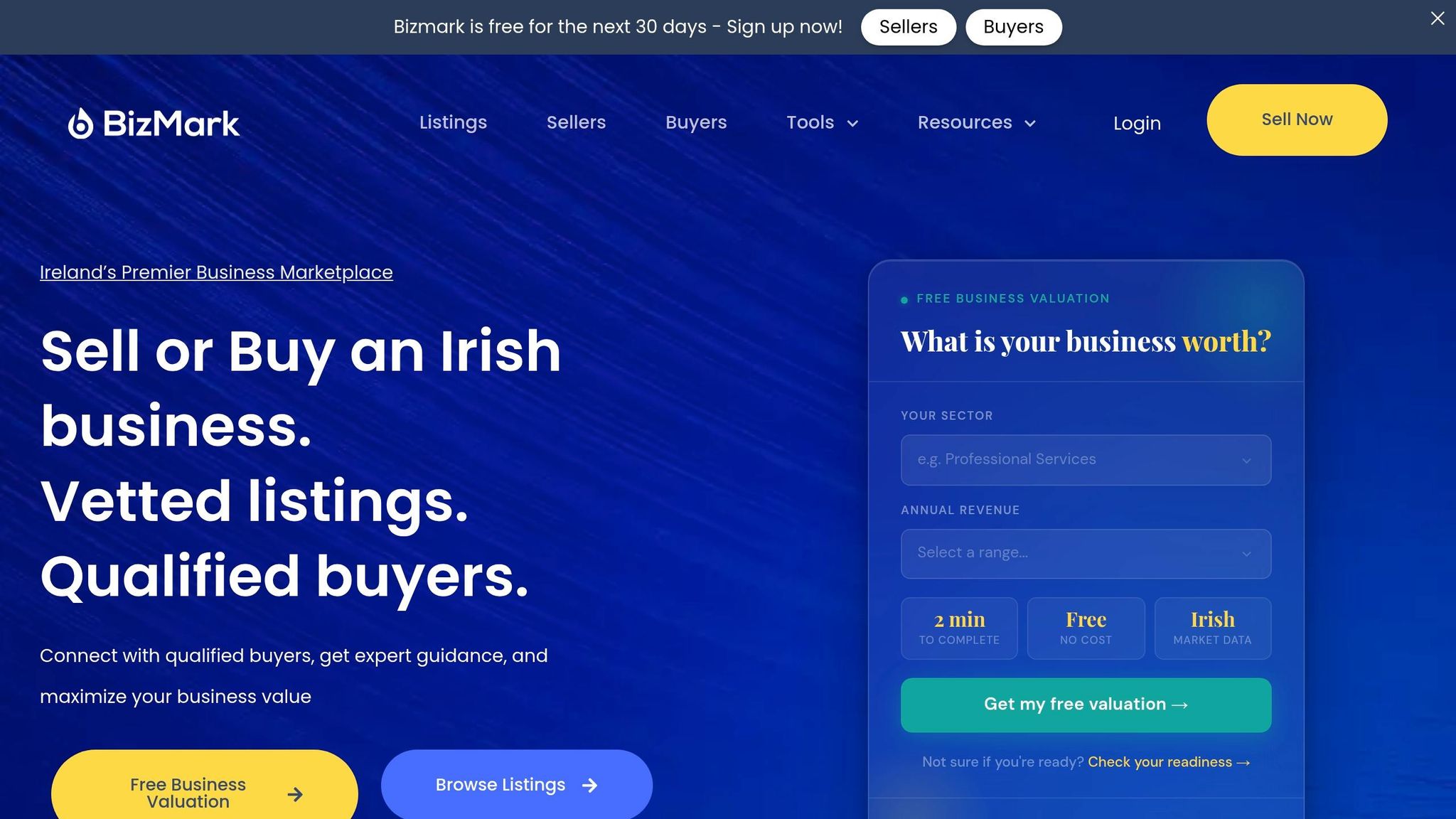
Reliable financial data is the backbone of a strong CIM. Bizmark’s free valuation tool can help you determine a credible asking price by using real-time Irish market data. All you need to do is enter your business sector and annual revenue range, and you’ll receive a market-based valuation in just two minutes.
For example, a Dublin-based HR SaaS company secured a sale price of €720,000, with valuation multiples of 7.06X Profit and 1.71X Revenue. Similarly, a specialty coffee shop near Eyre Square in Galway achieved a valuation of €185,000, based on a 2.72X Profit multiple – thanks to its award-winning reputation and loyal customer base.
Before finalising your asking price, use Bizmark’s “Sell Now” feature to get a broker’s review of your financial standing. This ensures your CIM aligns with current market expectations and strengthens buyer confidence.
Step 2: Set Up Non-Disclosure Agreements (NDAs)
An NDA is a legal tool that prevents potential buyers from sharing or misusing your confidential information. Without one, competitors could gain access to sensitive details like trade secrets, customer lists, or financial data. This step is crucial for maintaining confidentiality during the sale of your Irish SME.
In Ireland, NDAs are typically enforceable for three to five years. However, certain sensitive data – such as employee information or contracts tied to pricing – might need longer protection. To ensure its validity, your NDA must comply with Irish legal standards and include all necessary safeguards right from the start.
What to Include in Your NDA
For an NDA to hold up in Irish courts, it must be clear and specific. Start by identifying the parties involved – the disclosing party (you) and the receiving party (the potential buyer) – and state the purpose of sharing the information, such as “evaluating the business for a potential acquisition”.
Next, define what qualifies as confidential information. This usually includes intellectual property, trade secrets, customer lists, financial records, and business strategies. Avoid vague or overly broad definitions, as they can weaken the agreement’s enforceability.
Include a non-circumvention clause to prevent buyers from bypassing you to deal directly with your employees, customers, or suppliers during negotiations. This protects your business relationships throughout the process.
Lastly, detail the consequences of a breach. Outline remedies like injunctions to stop further disclosures and claims for financial damages. Make sure the agreement specifies that it is governed by Irish law and falls under the jurisdiction of Irish courts.
“NDAs must meet certain requirements for them to be considered both legal and ethical… it’s important to consult a solicitor to ensure you stay up to date on the rapidly changing regulations surrounding NDAs.”
Keep in mind that the Employment Equality (Amendment) (Non-Disclosure Agreements) Bill 2021 limits NDAs from covering workplace harassment, discrimination, or criminal acts. Always consult an Irish solicitor to ensure your NDA complies with the latest legislation.
Once your NDA is properly drafted, focus on executing it effectively.
Simplifying the NDA Process
Speed matters when it comes to NDAs. Use electronic signature tools to quickly finalise agreements and maintain a secure digital record. This ensures confidentiality is in place before sharing any sensitive information.
To make this process even smoother, platforms like Bizmark include built-in confidentiality measures. When a potential buyer shows interest, the system automatically prompts them to sign an NDA before granting access to your Confidential Information Memorandum. This automation not only saves time but also ensures your sensitive data stays protected.
Additionally, before granting full access to your business details, request proof of funds or a Personal Financial Statement alongside the signed NDA. This added step helps filter out unqualified buyers, ensuring that only serious prospects gain access to your information.
Step 3: Create Blind Listings and Teasers
After securing NDAs, the next step is to use blind listings to protect your business’s identity while attracting potential buyers. A blind listing allows you to market your business discreetly, ensuring sensitive details remain secure. This approach is an effective way to generate interest and find qualified buyers without immediately revealing the identity of your company.
Blind listings have been a reliable method for closing deals while maintaining confidentiality. In Ireland, professional business brokers have been successfully facilitating such sales across various industries for over a decade.
What to Include in a Blind Listing
A well-crafted blind listing should strike a balance between providing enough information to attract serious buyers and keeping your business’s identity private. Here’s what you should include:
Industry sector: Specify the type of business you’re in.
General location: Use broad terms like the county or region.
Key financial highlights: Share figures such as recent revenue and the asking price.
Operational details: Mention the number of employees and years in operation.
Unique advantages: Highlight what sets your business apart, without revealing identifiable details.
Avoid including specifics like your company name, exact address, unique product names, or any other distinctive characteristics. Any material defects or additional sensitive information should only be disclosed after an NDA is in place.
Using Bizmark for Private Listings
For Irish SMEs, Bizmark offers a platform tailored to confidential sales. It simplifies the process by focusing on your business’s strengths while safeguarding its identity. Each listing is reviewed by the Bizmark team before it goes live, ensuring it provides enough detail to attract interest without compromising privacy.
Bizmark connects you to a network of over 1,000 vetted buyers. All enquiries are screened, and strict NDAs, along with secure communication channels, ensure your business remains protected throughout the process. Sellers on the platform have reported receiving serious enquiries within three days and completing sales within just 60 days. You can start with a free 30-day trial to explore the platform or opt for a premium listing to boost visibility among targeted buyers.
Step 4: Screen and Prequalify Buyers
Once you’ve sparked interest through blind listings, the next step is to screen potential buyers. This process ensures confidentiality while narrowing the pool to those with the financial capacity and genuine intent to proceed. By focusing on qualified prospects, you save time and protect sensitive business information. This initial filtering sets the stage for more detailed prequalification.
How to Prequalify Buyers
To gauge a buyer’s suitability, request documentation similar to what Irish banks use for credit evaluations. Ask for a business plan and cash flow forecast to evaluate their strategic goals and financial preparedness. Verify their funding sources, such as support from SBCI or Microfinance Ireland, and confirm they meet SME standards: fewer than 250 employees and an annual turnover of no more than €50 million. It’s also important to ensure they have professional representation.
Additionally, perform formal Know Your Customer (KYC) checks. This involves collecting proof of identity (like a passport or driving licence) and proof of address (such as a utility bill or bank statement). Ask for a clear statement outlining the buyer’s business purpose and their intended activities.
Using Bizmark’s Buyer Matching Tools
Bizmark makes the screening process more efficient by pre-filtering all enquiries before they reach you. As Bizmark explains:
We ensure that every buyer that can contact you is serious and real.
Their smart search technology connects your business with buyers actively searching for opportunities in your specific sector and price range. Every enquiry is pre-screened for quality, and Bizmark’s team of business brokers provides extra support in assessing prospects. This approach ensures you only deal with genuine, pre-vetted buyers.
Step 5: Share Information in Phases
When you’re navigating a business sale, it’s crucial to handle sensitive information carefully. Dumping all your business details at once can lead to unnecessary risks – competitors might exploit the data, employees could grow unsettled, or potential buyers might use it to gain an upper hand in negotiations. Instead, share details step-by-step, building trust and commitment gradually.
How to Share Initial Information
Once a buyer signs the NDA, provide a uniquely numbered Confidential Information Memorandum (CIM). Each copy should include a unique identifier, the buyer’s name, and the date (DD/MM/YYYY). This small step adds accountability, making it easier to trace any leaks. To distribute documents securely, use a virtual data room designed for this purpose. Irish business brokers note that while 70% of information leaks occur before NDAs are signed, this figure drops below 10% when NDAs are paired with controlled sharing methods.
During early discussions, stick to broad, high-level topics. For instance, instead of sharing detailed profit and loss statements, describe your business’s performance using ranges like “annual turnover between €5 million and €10 million.” Highlight your market position, industry trends affecting Irish SMEs, and how your business aligns with the buyer’s goals, but avoid disclosing specific customer names, supplier contracts, or proprietary processes at this stage.
Once the buyer completes their initial review, you can move to in-person or virtual meetings to continue the process while keeping control over the information flow.
Arranging Meetings and Controlling Information Flow
After the initial phase, arrange secure meetings to advance discussions while maintaining confidentiality. Use neutral, professional locations or secure virtual platforms for these meetings. Avoid hosting them at your business premises to prevent employees or customers from becoming aware of the sale. For example, an Irish software company used co-working spaces during its sale process, which brokers reported helped reduce leak risks by 90%.
When using virtual platforms, prioritise security features like end-to-end encryption and waiting rooms to control access. Platforms like Bizmark offer additional safety measures. Their virtual data room allows you to control what each buyer can view, tracks access times (DD/MM/YYYY HH:MM), and even lets you set expiration dates on shared links. A Galway hospitality business once used these tools to monitor 15 buyer accesses and swiftly revoke access for one suspicious IP address. All data is hosted on EU servers, ensuring GDPR compliance and giving you full control over sensitive information throughout the sale process.
Step 6: Secure Letters of Intent (LOIs)
After sharing initial details and holding productive discussions with serious buyers, it’s time to formalise their interest. A Letter of Intent (LOI) sets out the preliminary terms for purchasing your business, laying the groundwork for due diligence and purchase agreement negotiations. This document shifts the process from casual talks to a more structured phase, aligning key deal points.
In a confidential sale, the LOI serves as a critical safeguard. Highly sensitive information – like customer names, employee details, or proprietary processes – should only be disclosed once an LOI is in place. This ensures you’re protected from buyers who might be fishing for competitive insights. However, keep in mind that over half of deals fall apart even after an LOI is signed. Securing one, though, is a strong indicator of genuine interest before revealing your most valuable business details.
What to Include in an LOI
A well-constructed LOI should clearly outline essential terms, providing clarity and protecting both parties. For instance, the purchase price and payment terms must be explicitly stated, such as: “€850,000 for 100% of shares, payable in cash at closing, with potential seller financing or earnouts”. While these terms are generally non-binding until the final purchase agreement, significant deviations later can jeopardise the deal.
The LOI should also define an exclusivity period, usually lasting 45 to 60 days. During this time, you agree not to negotiate with other buyers. To safeguard your position, include provisions that allow you to terminate exclusivity if the buyer fails to meet specific milestones, such as providing proof of funds within three days of signing.
“The price and terms you ultimately receive are affected more by how strongly you negotiate the LOI than by how strongly you hammer out the purchase agreement. Signing a strong LOI that protects your interests is like getting the ball 30 yards from the endzone, whereas signing a weak LOI is like starting on your own 20-yard line with 80 yards to go.” – Jacob Orosz, President, Morgan & Westfield
Additionally, the LOI should specify a closing date (e.g., 90 days from signing) to prevent unnecessary delays. Include a clear working capital calculation to avoid surprises after closing, and clearly mark which sections are binding – such as confidentiality, exclusivity, and expense allocation – and which are non-binding, like the purchase price and payment structure.
How Bizmark Supports LOI Negotiations
Navigating LOI negotiations can be challenging, especially when balancing confidentiality with transparency. Once a buyer shows serious intent, Bizmark steps in to connect sellers with pre-screened, qualified buyers – ensuring the LOI comes from someone with genuine interest and the financial means to follow through. Their team provides tailored support during negotiations, helping secure fair terms, while their market-based valuations ensure competitive pricing. Throughout the process, Bizmark’s secure communication channels protect confidentiality.
“Bizmark helped us realise there was value in our brand and relationships. This was a big bonus to us getting an unexpected exit quickly.” – Mary M, Business Seller
With LOIs in place, you’re ready to move confidently into the due diligence and closing stages.
Step 7: Manage Due Diligence and Closing Privately
Once you’ve secured LOIs, the process shifts to an even more delicate phase: due diligence and closing. This stage requires meticulous attention to confidentiality. You’ll be sharing highly sensitive information – like financial records, customer lists, employee contracts, and proprietary data – and any leaks could disrupt your operations. The trick is to maintain tight control over who accesses what, and when.
Proper oversight ensures the transaction runs smoothly without interfering with day-to-day business. Just as NDAs and secure data sharing were crucial earlier, maintaining strict confidentiality during due diligence is essential for a successful sale. While your management team stays focused on meeting financial targets – critical for supporting your valuation – your advisers should handle the sale’s technicalities.
Organising and Securing Due Diligence Documents
To prepare, consider conducting vendor due diligence. This involves having your solicitors pre-assess your business to identify and address potential issues before buyers get involved. It’s a proactive way to avoid surprises that could derail negotiations or compromise confidentiality.
Store all key documents on a secure, encrypted platform. Essential files include signed contracts with major customers and suppliers, intellectual property ownership records (especially assignments from developers and employees), Open Source Software registers, and compliance documentation regarding employee share schemes for Irish Revenue. Review contracts for change-of-control clauses, as these might require consent from suppliers or customers.
When sharing information, take it step by step. Start with broad financial summaries, only moving to detailed disclosures once the buyer has proven their commitment. Use advanced access controls to monitor who views what and when. Tools like Bizmark’s integrated escrow service offer encrypted channels with detailed audit trails, ensuring sensitive materials are shared securely and only with serious, pre-qualified buyers.
“The disclosure process can be a difficult, stressful, and time-consuming exercise, but you can avoid a lot of headaches if you and your team are prepared for it and problems are dealt with in advance.” – Taylor Wessing
Identify and address possible roadblocks early. For example, you may need consents from lenders, shareholders, or regulators, so resolving these in advance helps maintain momentum and avoid leaks. For trade secrets and other unregistered IP, implement strict protocols to ensure their protection during disclosure.
Finalising the Sale with Irish Legal Expertise
Building on earlier confidentiality measures, now is the time to work with Irish solicitors who specialise in SME transactions. Just as NDAs safeguarded your data early on, experienced solicitors will protect sensitive information and ensure agreements are watertight. They’ll also help include non-compete and confidentiality clauses in service contracts for key management, safeguarding the business after the sale.
Your legal team should confirm all IP ownership is properly documented. Any issues here typically need resolving before closing, so addressing them early will streamline the process. Additionally, keep an eye on any ongoing litigation or regulatory matters, and provide buyers with clear explanations to minimise potential impacts on valuation. Historical grant records and valuations for share options should also be on hand to meet due diligence requirements for Irish tax-favoured treatments.
Solicitors will coordinate the final share purchase agreement, ensuring it aligns with the LOI while protecting your interests. Throughout the closing process, maintain discretion. Hold meetings off-site, use secure communication channels, and limit the number of participants. Your advisers act as intermediaries, managing buyer queries so you can stay focused on running the business.
With careful planning and the right professional support, you can complete the sale privately, maintaining strong relationships with employees, customers, and suppliers until the time is right to announce the transition.
Conclusion: Completing a Confidential and Successful Sale
Keeping your business sale confidential is key to protecting its value and ensuring a smooth transition. By following a thoughtful approach, you can safeguard your business throughout the process. This involves steps like preparing a detailed Confidential Information Memorandum, securing NDAs, using blind listings, carefully vetting potential buyers, sharing sensitive information in stages, obtaining Letters of Intent, and handling due diligence discreetly. Together, these steps underline the importance of confidentiality discussed earlier.
Having precise financial data, well-organised records, and the guidance of experienced advisors forms a solid base for success. As the Bank of Ireland advises:
“It is always a good idea to consult with your financial advisor/accountant to seek assistance and/or review any proposal in advance of meeting with us.”
FAQs
When should I tell staff and customers I’m selling?
When you’re planning to sell your business, timing is everything – especially when it comes to informing your staff and customers. It’s generally a good idea to hold off on sharing the news until you’ve secured a qualified buyer and have a solid transaction plan in place. This careful approach helps maintain confidentiality, protects the value of your business, and reduces the risk of unnecessary disruptions during the sale process.
What should I share before I get an LOI?
Before a Letter of Intent (LOI) is signed, it’s best to stick to sharing only the bare essentials about your business. This might include a brief overview of your operations, a summary of financial performance, and a highlight of key assets. Keep any sensitive or detailed information under wraps until the LOI is in place. Once signed, and with proper confidentiality agreements, you can safely provide more in-depth disclosures later in the process.
How do I spot a buyer who isn’t genuine?
Watch out for warning signs like requests for immediate payments, reluctance to provide verifiable contact information, or odd behaviour during negotiations. Scammers might use newly created profiles or provide conflicting details. Stay cautious with buyers who avoid being upfront or rush transactions without proper checks. Always confirm credentials and only share sensitive information once you’re certain the buyer is genuine.

 Reliable financial data is the backbone of a strong CIM. Bizmark’s free valuation tool can help you determine a credible asking price by using real-time Irish market data. All you need to do is enter your business sector and annual revenue range, and you’ll receive a market-based valuation in just two minutes.
For example, a Dublin-based HR SaaS company secured a sale price of €720,000, with valuation multiples of 7.06X Profit and 1.71X Revenue. Similarly, a specialty coffee shop near Eyre Square in Galway achieved a valuation of €185,000, based on a 2.72X Profit multiple – thanks to its award-winning reputation and loyal customer base.
Before finalising your asking price, use Bizmark’s “Sell Now” feature to get a broker’s review of your financial standing. This ensures your CIM aligns with current market expectations and strengthens buyer confidence.
Reliable financial data is the backbone of a strong CIM. Bizmark’s free valuation tool can help you determine a credible asking price by using real-time Irish market data. All you need to do is enter your business sector and annual revenue range, and you’ll receive a market-based valuation in just two minutes.
For example, a Dublin-based HR SaaS company secured a sale price of €720,000, with valuation multiples of 7.06X Profit and 1.71X Revenue. Similarly, a specialty coffee shop near Eyre Square in Galway achieved a valuation of €185,000, based on a 2.72X Profit multiple – thanks to its award-winning reputation and loyal customer base.
Before finalising your asking price, use Bizmark’s “Sell Now” feature to get a broker’s review of your financial standing. This ensures your CIM aligns with current market expectations and strengthens buyer confidence.